
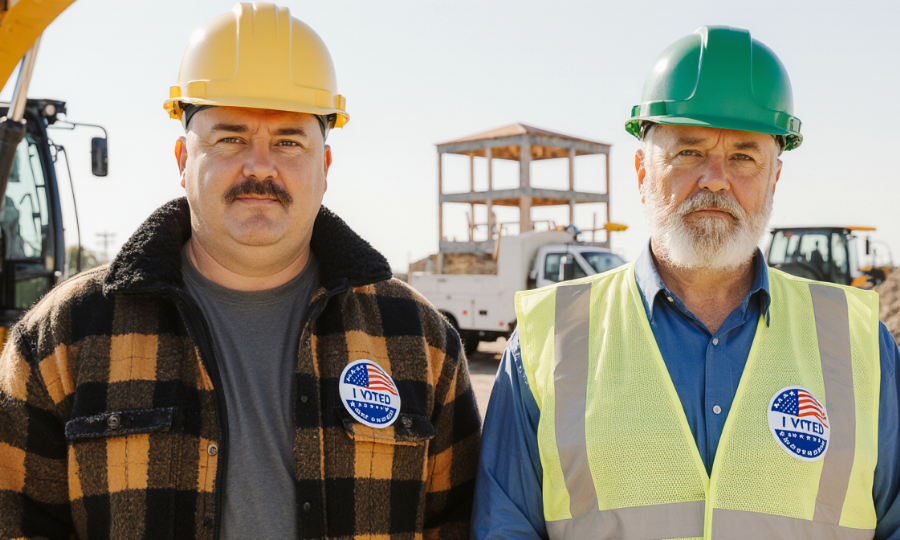
Let us speak plainly about the crossroads facing the Democratic Party.
Ezra Klein — a New York Times commentator who presents himself as moderate while championing what amounts to a progressive wish list in his book Abundance — it has been reported that he now positions himself as a Democratic powerbroker. I have listened to some of his podcasts. I have learned from some of them. But make no mistake: Klein represents precisely the tendency that has driven working people away from the party that once championed their cause.
To his credit, Klein advocates for a "big tent" Democratic Party. But, what good is talk of a big tent when the party systematically excludes the very candidates working people would choose? Klein never addresses how moderate candidates can survive closed primaries dominated by activist bases. He never explains why representatives like Jared Golden — who actually win in working-class districts — have become so rare. And here is the uncomfortable truth: Klein himself would likely never vote for a Jared Golden in a primary in his own district.
This is the contradiction at the heart of the Democratic Party's crisis.
According to Axios, Klein recently influenced Democratic Senators to reject a Continuing Resolution that would have funded the government. Whether this reporting is accurate or not, the broader pattern is undeniable: the party increasingly answers to voices disconnected from the struggles of ordinary Americans. This is a betrayal of everything the Democratic Party used to stand for.
The Democratic Party was built by and for working people. It was the party that fought for fair wages, safe working conditions, and economic dignity. It also listened to moderate voices on social issues. But somewhere along the way, it became the party of educated elites talking about working people rather than listening to them. It became the party of symbolic gestures while bread costs more, wages stagnate, and most importantly jobs were exported to other countries. It became the party that tells workers their concerns are less important than the priorities of Let us speak plainly about the crossroads facing the Democratic Party.
Ezra Klein — a New York Times commentator who presents himself as moderate while championing what amounts to a progressive wish list in his book Abundance — it has been reported that he now positions himself as a Democratic powerbroker. I have listened to some of his podcasts. I have learned from some of them. But make no mistake: Klein represents precisely the tendency that has driven working people away from the party that once championed their cause.
To his credit, Klein advocates for a "big tent" Democratic Party. But, what good is talk of a big tent when the party systematically excludes the very candidates working people would choose? Klein never addresses how moderate candidates can survive closed primaries dominated by activist bases. He never explains why representatives like Jared Golden — who actually win in working-class districts — have become so rare. And here is the uncomfortable truth: Klein himself would likely never vote for a Jared Golden in a primary in his own district.
This is the contradiction at the heart of the Democratic Party's crisis.
According to Axios, Klein recently influenced Democratic Senators to reject a Continuing Resolution that would have funded the government. Whether this reporting is accurate or not, the broader pattern is undeniable: the party increasingly answers to voices disconnected from the struggles of ordinary Americans. This is a betrayal of everything the Democratic Party used to stand for.
The Democratic Party was built by and for working people. It was the party that fought for fair wages, safe working conditions, and economic dignity. It also listened to moderate voices on social issues. But somewhere along the way, it became the party of educated elites talking about working people rather than listening to them. It became the party of symbolic gestures while bread costs more, wages stagnate, and most importantly jobs were exported to other countries. It became the party that tells workers their concerns are less important than the priorities of activist circles and coastal powerbrokers.
And working people noticed.
They noticed when the party championed policies that sounded progressive in faculty lounges but felt disconnected from their daily reality. They noticed when cultural signaling replaced economic transformation. They noticed when the Democrats who once fought corporations began taking their money and counsel.
So they walked away. Not because they abandoned progressive values — but because they felt the party abandoned them.
As long as figures like Alexandria Ocasio-Cortez, Ezra Klein, and Ilhan Omar hold disproportionate sway — as long as the party elevates voices that speak to narrow constituencies rather than the broad working class — I do not see Democrats recovering the voters they desperately need.
But here is what I know: we do not have to wait for them.
The Democratic Party has had its chance. Decades to prove it still serves working people. Decades to reform itself from within. And what has changed? The elites strengthened their grip. The powerbrokers protect their positions. The party that once belonged to workers now belongs to donors and consultants and voices that have never struggled to pay rent or afford healthcare.
So I say to you today: it is time to build something new.
Not another reform caucus within a party that refuses to reform. Not another primary challenge that gets crushed by institutional power. But a genuine alternative — a third party built from the ground up by and for working people. A party that answers to us, not to corporate interests. A party where Jared Golden types are the norm, not the exception. A party that puts economic dignity ahead of factional ideology.
They will tell you it cannot be done. They will say the system is too entrenched, that third parties cannot win, that you are wasting your vote. But, what is truly wasted is continuing to support parties that have abandoned their founding principles. What is truly impossible is expecting different results while repeating the same failed choices.
This is not about ideology — it is about representation.
It is about workers having a party that actually fights for living wages instead of just talking about them. It is about families having a party that prioritizes affordable housing over coastal real estate interests. It is about communities having a party that listens to their needs instead of lecturing them about their priorities. It is a party that says you are somebody.
And yes, it will be difficult. Building a movement always is. The established powers — Democratic and Republican alike — will unite against any threat to their duopoly. The media will dismiss us. The money will flow against us.
But we have something they do not: the people.
When working Americans across this nation — black and white, urban and rural, young and old — unite around economic dignity and genuine representation, we become unstoppable. When we organize community by community, district by district, state by state, we build power that cannot be ignored.
The Democratic Party had its chance to be this vehicle. It chose otherwise. So now we must build our own.
Not someday. Not after one more election cycle. Now!
Because every day we wait is another day working people suffer under a system designed to benefit everyone except them. Every day we delay is another generation told their voices do not matter.
The future belongs to those brave enough to build it.
Thank you, and let us begin this work together.


Lorem ipsum dolor sit amet, consectetur adipiscing elit. Suspendisse varius enim in eros elementum tristique. Duis cursus, mi quis viverra.